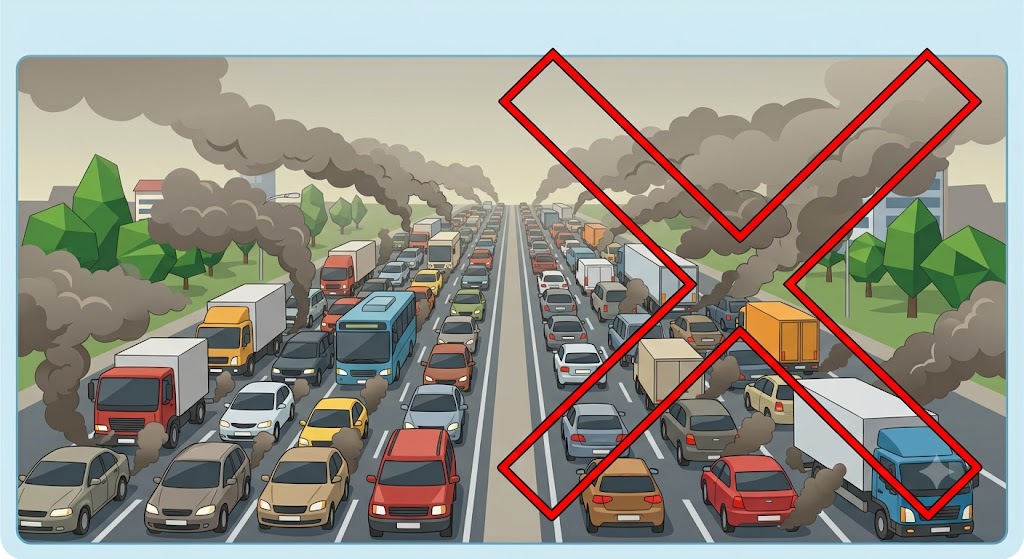
Europe’s automotive sector is facing its biggest regulatory shift of the decade. The new Euro 7 standard and the tightening of emissions controls will set the agenda between 2026 and 2027, affecting manufacturers, workshops, vehicle inspection centres and fleets alike. In this guide we break down the essentials —with official sources— and explain why keeping combustion clean will matter more than ever.
What is the Euro 7 standard?
Euro 7 is the new European emissions standard adopted under Regulation (EU) 2024/1257. For the first time it unifies the Euro 6 and Euro VI rules into a single legal framework that covers not only tailpipe gases but also particulate matter from brakes and tyres, as well as battery durability.
The focus falls on the most closely watched pollutants: nitrogen oxides (NOx), airborne particles and emissions under real-world driving conditions, not just in the lab.
2026–2027 timeline: when does it come into force?
Euro 7 is being phased in depending on the vehicle type. Here’s the big picture:
| Vehicle type | When | What changes |
|---|---|---|
| Cars and vans (M1 / N1) | ≈ 2026–2027 | Brake particle control and extended durability (200,000 km / 10 years) |
| Trucks and buses (M2 / M3 / N2 / N3) | After light vehicles | Stricter NOx limits and real-world testing |
| Workshops & roadworthiness tests | Progressive | More vehicles will need their combustion and after-treatment systems kept clean |
Exact application dates may be adjusted through delegated acts of the European Commission. Always check the text of Regulation (EU) 2024/1257 and your type-approval authority.
The role of TÜV and certification
Bodies such as TÜV NORD and TÜV SÜD are European benchmarks in vehicle and automotive-product homologation, testing and certification. As Euro 7 tightens the thresholds, working with certified products —like our additives, certified by TÜV NORD— stops being a nice-to-have and becomes a safeguard against increasingly demanding inspections.
How HHO decarbonization helps
Over time, every engine builds up carbon deposits on valves, injectors, the combustion chamber, the exhaust gas recirculation (EGR) system and the intake. That carbon worsens combustion, raises fuel consumption and drives up NOx and particulate emissions —exactly what Euro 7 scrutinises most.
OXYHTECH’s HHO (oxyhydrogen) technology injects a hydrogen-and-oxygen mix into the intake to clean carbon from the inside, without dismantling the engine. The result: more efficient combustion, less smoke and a vehicle that performs —and emits— the way it should.
- Lower emissions: clean combustion reduces smoke, NOx and particulates.
- Better performance: restores power and response and lowers fuel consumption.
- No dismantling: a fast, non-invasive process that cleans the engine from within.
- A new service: profitable and differentiating, aligned with the demand Euro 7 will bring.
Discover our decarbonization machines
Professional HHO equipment NOVA 4.0 and ULTRA 4.0: technology that cleans the engine from the inside and gets your customers ready for the regulations ahead.
View products →Frequently asked questions
No. Euro 7 tightens emissions limits, but combustion engines will keep being type-approved and on the road for years. That’s exactly why maintenance is key.
It’s phased in: cars and vans first (around 2026–2027) and heavy-duty vehicles afterwards. Final dates depend on the European Commission’s delegated acts.
Yes. OXYHTECH’s HHO technology acts on carbon deposits in both diesel and petrol engines, improving combustion in either case.