Not so long ago, laser welding was reserved for large factories: industrial robots, enclosed cells and six-figure investments. Today, that same technology fits into a portable machine you can plug in at any workshop. And it’s just one example of an unstoppable trend: we keep getting tools that make the job easier, faster and more profitable.
In this article we look at what laser welding is, which innovations are reaching workshops and industry, and what a machine of barely 40 kg can do today — with a real customer case on video included.
What is laser welding and why is everyone talking about it?
Laser beam welding uses a concentrated beam of laser light to melt and join metal with a precision no traditional method can match. Unlike TIG or MIG welding, the heat is applied to a tiny spot, which means:
- The part barely distorts: the heat-affected zone is minimal — ideal for thin sheets and delicate parts.
- The finish comes out clean: fine, neat weld seams that need almost no grinding or polishing afterwards.
- It’s much faster: up to several times the speed of conventional welding.
- It joins difficult materials: stainless steel, aluminium, galvanised steel, copper… even very thin gauges that TIG would burn through.
- The learning curve is short: where a TIG welder needs years of experience, an operator can handle a laser in a matter of days.
Technology keeps making things easier for us
Portable laser welding is not an isolated case. In recent years, technology for workshops and industry has been moving in one direction: making accessible what used to be exclusive.
Equipment that used to fill a room now fits on a trolley
Fiber lasers have miniaturised what used to be full-scale installations. A modern portable unit weighs about as much as a large suitcase, moves between workstations and can even go out on jobs away from the workshop.
One machine, several trades
The big trend is multifunction: the same laser head that welds also cuts, removes rust and paint, and strips surfaces without abrasives or chemicals. Four billable services with a single investment and no tool changes.
Interfaces designed for the operator, not the engineer
Screens with preset programs by material and thickness: select, adjust and work. The electronics do the rest. This cuts errors, training time and dependence on ultra-specialised staff — one of the sector’s biggest headaches, with qualified welders becoming harder and harder to find.
Fewer consumables, fewer stoppages
Compared to the electrodes, gas and grinding discs of traditional techniques, a laser runs on minimal consumables. Less consumable material means lower cost per job and fewer interruptions.
NOVALASER: 40 kg that work wonders
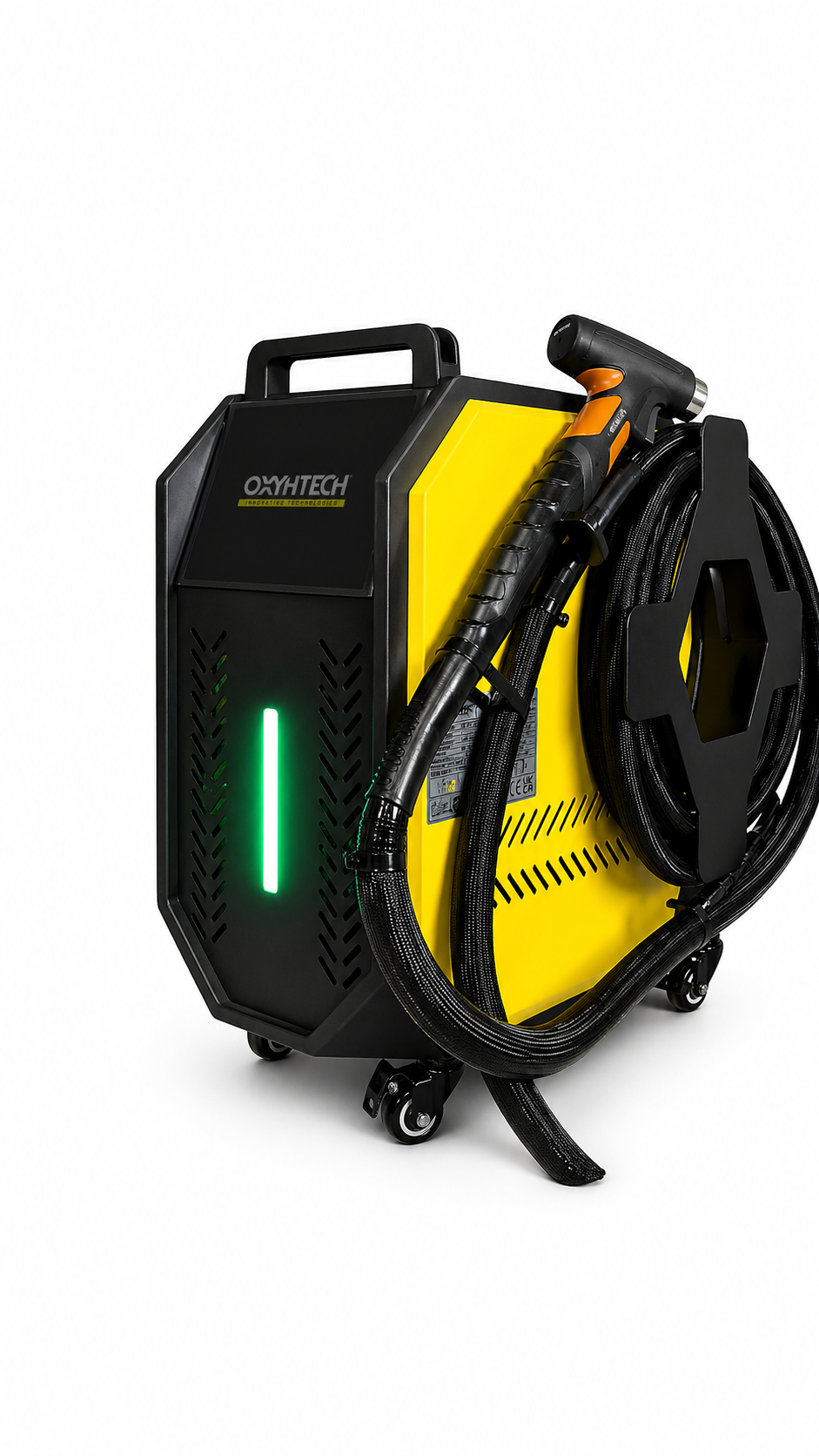
A perfect example of all the above is the NOVALASER by OXYHTECH: a 4-in-1 laser machine of just 40 kg that welds, cuts, cleans and strips. A single portable unit that replaces several workstations and opens up new revenue streams: part repair, restoration, custom fabrication, mould and tooling cleaning…
But rather than us telling you, let a customer show you. This is how they work with their NOVALASER day to day:
You can watch the full video on our channel: NOVALASER testimonial on YouTube.
Jobs that used to be turned down for lack of equipment — or subcontracted at the cost of margin — are now solved in-house, same day, with a finish the customer can see at a glance.
What does this mean for your workshop?
That the barrier to entry is gone. What a few years ago required an industrial unit and a welder with twenty years of experience is now solved with a portable machine and a few days of practice. And whoever adopts it first takes the advantage:
- New billable services that most of your competitors still don’t offer.
- Jobs that no longer get away: that aluminium or stainless steel repair you used to turn down is now a yes.
- More margin per hour: higher working speed and finishes that barely need reworking.
- A reputation as an innovative workshop, attractive to both private customers and industrial clients.
Conclusion: the future of the workshop is already here
The story of technology in the workshop has always been the same: what starts in heavy industry ends up, sooner or later, in the hands of the professional. With laser welding, that moment has arrived. Portable, multifunctional, easy-to-use machines are changing what a workshop can offer — and those who adopt them first are the ones who stand out.
Things keep getting easier for us. The question is: is your workshop going to wait for the competition to do it first?