
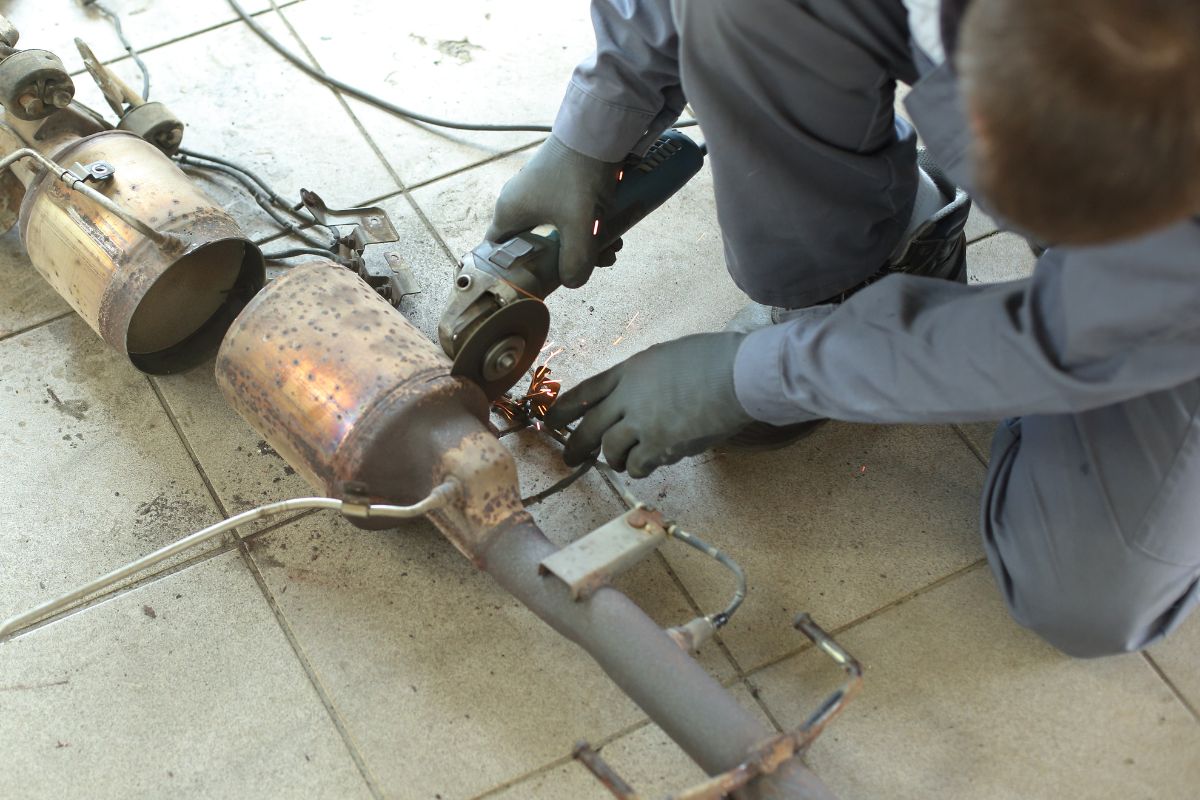
The difference between cleaning a clogged DPF and replacing it with a new one lies in the degree of saturation and the structural condition of the filter: cleaning restores the original DPF when it is still recoverable, while replacement is only necessary when the filter is physically damaged or collapsed.
At Oxyhtech, we tell you everything you need to know about the differences between cleaning a clogged DPF and replacing it with a new one.
What does it really mean for a DPF to be clogged?
A clogged DPF is one that has accumulated soot and ash to a level that prevents the normal flow of exhaust gases.
The DPF (Diesel Particulate Filter) is designed to retain solid particles, but it has a limit. When this limit is exceeded:
- Back pressure increases.
- The engine is forced to work harder.
- Regenerations fail.
- Warnings and emergency mode appear.
Real example
An urban diesel vehicle with short journeys begins to regenerate every few kilometers. The DPF is not yet broken, but it is saturated.
Important distinction
Clogged does not mean broken. And that is where many diagnostic errors begin.
What does cleaning a clogged DPF involve?
Cleaning a clogged DPF involves removing the accumulated soot and ash to restore its original filtering capacity.
Professional cleaning acts on:
- Soot (carbon deposits).
- Ash derived from oil.
- Solid residues that are not removed by regeneration.
Depending on the level of saturation, cleaning can be:
- Preventive.
- Corrective.
- Thorough.
Workshop example
A DPF with high back pressure returns to normal values after professional cleaning, avoiding replacement.
When is it feasible to clean a clogged DPF?
Cleaning is feasible when the filter retains its internal structure and shows no physical damage.
Common cases where cleaning works
- Saturation due to urban use.
- Interrupted regenerations.
- Excess carbon deposits.
- FAP with accumulated ash but intact.
Signs that cleaning is possible
- The filter is not fractured.
- There is no internal fusion.
- The diagnosis shows saturation, not breakage.
In what cases is cleaning the FAP NOT sufficient?
Cleaning is not sufficient when the DPF is structurally damaged.
Cases where replacement is considered
- Cracked or broken DPF.
- Melting of the ceramic material.
- Irreversible internal collapse.
- Damage due to extreme overheating.
- Previous incorrect handling.
Key point for workshops
These cases are less frequent than they seem. Many filters are replaced without any real need.
What does replacing a DPF with a new one involve?
Replacing the FAP means completely replacing the original filter with a new approved one.
Replacement:
- Eliminates any problems with the old filter.
- Requires electronic adaptation.
- It involves a longer intervention time.
- Is the last technical option.
A particulate filter that has fractured internally following serious engine damage must be replaced because it cannot be cleaned.
Key differences between cleaning and replacing a clogged FAP
Cleaning is a recoverable technical solution; replacement is a definitive solution when there is no alternative.
Technical comparison
| FAP cleaning | FAP replacement |
| Recovers the original filter | Replaces the filter |
| Less intervention | Greater intervention |
| Keeps OEM components | New component |
| Ideal as a recurring service | Last resort |
| Minimal operational impact | Longer downtime |
Which option is best for the workshop?
From the workshop’s point of view, cleaning is a more flexible, cost-effective, and repeatable solution.
Advantages for the workshop
- Recurring service.
- Less dependence on stock.
- Real technical solution.
- Greater customer loyalty.
- Applicable to passenger cars, commercial vehicles, and trucks.
Replacement is necessary in specific cases, but should not be the first option without prior diagnosis.
How do you know whether to clean or replace a clogged DPF?
The decision should be based on diagnosis, not assumptions.
Recommended workshop process
- Fault reading.
- Back pressure measurement.
- Evaluate the physical condition of the filter.
- Determine whether the structure is recoverable.
- Clean or consider replacement.
What role does engine maintenance play in the life of the DPF?
A dirty engine drastically shortens the life of the DPF.
- Clogged EGR → more soot.
- Dirty injectors → poor combustion.
- Excessive carbon deposits → accelerated saturation.
Professional decarbonization is key here, as it reduces particle generation before they reach the DPF.
Quick technical summary
- A clogged DPF does not always need to be replaced.
- Cleaning restores recoverable filters.
- Replacement is reserved for structural damage.
- A good diagnosis prevents unnecessary replacements.
- Cleaning is key in passenger cars and commercial vehicles.
- Engine maintenance extends the life of the DPF.
Turn a clogged DPF into a service opportunity
Dealing with a clogged DPF is one of the most common situations in today’s diesel workshops. Knowing when to clean and when to replace allows you to offer an honest technical solution, avoid unnecessary costs for the customer, and improve vehicle efficiency.
At Oxyhtech, we help workshops incorporate specific solutions for cleaning and maintaining DPFs and DPFs, with products such as DPF Cleaner and DPF Cleaner Plus, as well as technical advice to correctly diagnose each case, both in passenger cars and commercial vehicles and trucks.
Do you want to improve the management of particulate filters in your workshop and avoid unnecessary replacements? Contact us and we will help you implement the most appropriate solution for your type of vehicle and workload.
Frequently asked questions about clogged FAPs
In most cases, it is better to clean the DPF if the filter has no structural damage. Cleaning restores the capacity of the original filter and avoids unnecessary replacements. Replacement should always be the last option after a complete diagnosis.
The cost of replacing a DPF varies considerably depending on the vehicle, the type of filter, and the work required. Factors such as certification, mechanical access, and programming have a direct influence. That is why it is essential to consider professional cleaning first.
Particulate filter regeneration usually takes between several minutes and more than half an hour, depending on the system and the level of saturation. If it is interrupted repeatedly, the process becomes ineffective. Failed regenerations are a clear sign of advanced saturation.
Driving with a clogged particulate filter can cause loss of power, turbo failure, and entry into emergency mode. In the long term, the damage can affect several engine systems. Timely intervention reduces risks and costs.